How to rank in AI Overviews: what Google says and what the data shows
By Michael Nefedov, noetio · Updated 21 October 2026
To rank in AI Overviews, your page must be indexed and eligible to show in Google Search with a snippet. Google's newer guide adds one condition: your site must be included in Search generative AI features in Search Console.
Short answer
- Google: normal SEO applies, with no special optimization for AI Overviews, plus one new condition.
- Top 10 helps but does not decide: Ahrefs found 76% (2025) and 38% (2026 update) of cited pages there.
- The 6 steps below are mostly basics. Steps 3 to 5 are our reading, not Google rules.
What Google documents about AI Overviews eligibility
Google asks for little: be indexed, be eligible for a snippet, and, per its newer guide, be included in generative AI features in Search Console.
Google describes this on two pages. AI features and your website shows 10 December 2025 as its last update. The newer guide to optimizing for generative AI features shows 10 July 2026. We read both on 21 October 2026. The key lines from the older page:
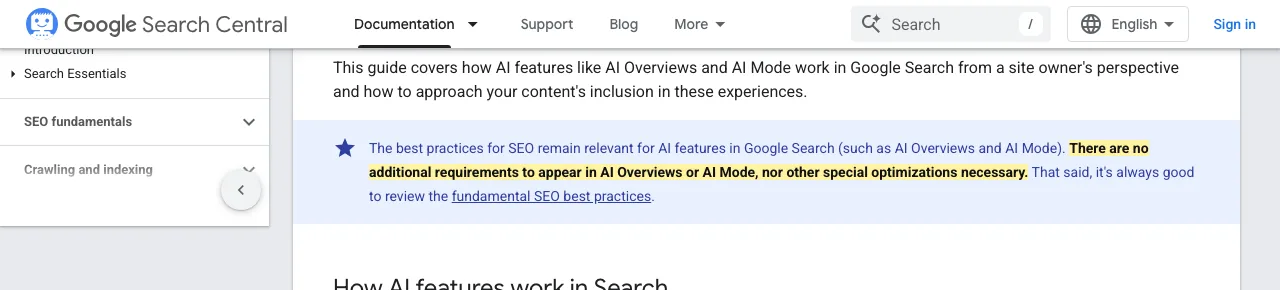
“There are no additional requirements to appear in AI Overviews or AI Mode, nor other special optimizations necessary.”
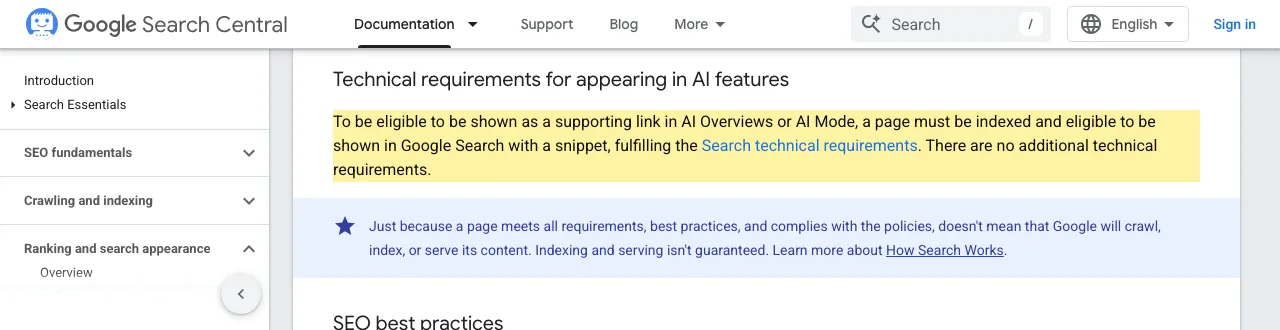
“a page must be indexed and eligible to be shown in Google Search with a snippet”
The newer guide adds this condition:
“In addition to the technical requirements for Search, a site must be included in Search generative AI features in Search Console to be eligible for display in generative AI features on Google Search.”
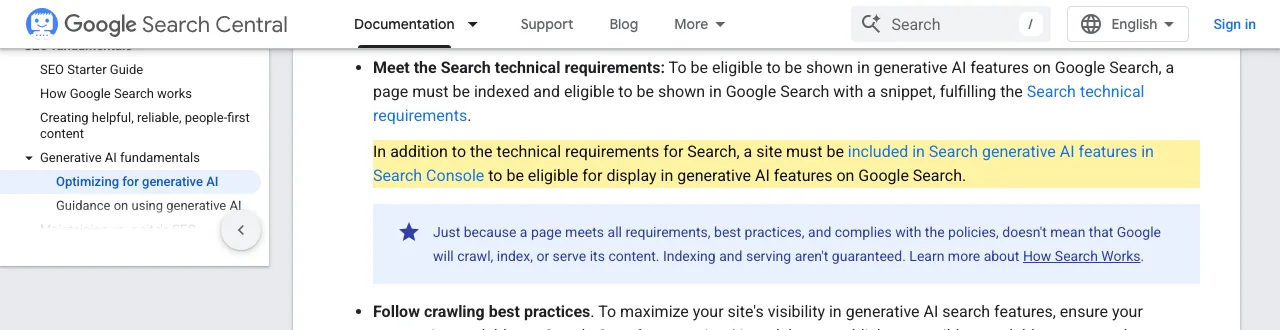
Google does not explain this further. Check the Generative AI performance report in your Search Console (step 6). The two Google pages differ here, and the newer one is the later source.
| Topic | What Google says |
|---|---|
| Special files or markup | “You don't need to create new machine readable files, AI text files, or markup” |
| Structured data | No special schema.org markup needed. Keep it matched to the visible text |
| How answers are built | May use “query fan-out”: several related searches across subtopics |
| Limiting your content | nosnippet, data-nosnippet, max-snippet or noindex |
| Reporting | Counted in Search Console's Performance report (Web search type), plus a separate Generative AI performance report (step 6) |
| Rewriting for AI | “You don't need to write in a specific way just for generative AI search” (guide, 10 July 2026) |
| Chunking and llms.txt | No need to break content into tiny pieces. Google Search “ignores” llms.txt files (guide, 10 July 2026) |
Google's guide does describe the method in general terms. The AI features use retrieval-augmented generation, “relying on our core Search ranking systems to retrieve relevant, up-to-date web pages”, plus query fan-out. It gives no ranking formula or list of factors for who gets cited. The data below is outside data, not a Google rule.
“Creating content that people find unique, compelling, and useful will likely influence your website's presence in generative AI search in the long run more than any of the other suggestions in this guide.”
What the data says about who gets cited
Ranking in the top 10 gives the best odds, but a page outside it can be cited.
76%
of cited pages ranked in the top 10 for the same query. 1.9 million citations from 1 million AI Overviews, July 2025.
Ahrefs. Source
37.9%
in the 2 March 2026 update (all result blocks counted): 863,000 keyword SERPs, 4 million cited URLs. Ahrefs rounds this to 38%.
Ahrefs, 2 March 2026. Source
- Top 1076.1%
- Positions 11 to 1009.5%
- Below position 10014.4%
Ahrefs, 1.9 million citations from 1 million AI Overviews (top 3 most visible citations per response), 21 July 2025. Source, read 21 October 2026.
All result blocks on the page counted, including ads and SERP features. With organic listings only, Ahrefs gives 37.1%, 26.2% and 36.7%.
- Top 1037.9%
- Positions 11 to 10031.2%
- Below position 10031.0%
Ahrefs, 863,000 keyword SERPs and 4 million cited URLs, 2 March 2026. Source, read 21 October 2026.

- Ahrefs says it improved its parsing method since 2025 and that the update covers more than double the data. Search Engine Journal, reporting on the update, says the two datasets are “not directly comparable” and part of the drop may be better detection, not a change at Google (SEJ, 2 March 2026).
- Ahrefs suggests fan-out queries may now play a bigger role in which pages are cited. Google has not confirmed a change.
- In the 2025 post, Ahrefs' Si Quan Ong is quoted on the chance that the page ranked first is cited: “a coin flip at best”.
That fits Google's fan-out note: a page may be picked because it answers a subtopic well. More on this in SEO vs GEO.
What Google's own tips say
Google's tips for AI search are mostly basics: useful content, a fast page, access and preview controls.
John Mueller's May 2025 post on the Google Search Central Bloglists them. In Google's words, in short:
| Tip | What the post says |
|---|---|
| Unique, valuable content | Make “unique, non-commodity content” that readers find helpful and satisfying |
| Page experience | Check that the page displays well across devices, loads fast, and lets visitors tell main content from other content |
| Access | Googlebot is not blocked, the page returns HTTP 200, and it has indexable content |
| Preview controls | Use nosnippet, data-nosnippet, max-snippet or noindex. “More restrictive permissions will limit how your content is featured in our AI experiences” |
| Structured data | Follow the guidelines. All content in the markup must also be visible on the page |
| Beyond text | Support text with high-quality images and video, and keep Merchant Center and Business Profile information up to date |
| Value of visits | Look at conversions such as sales, signups or information lookups, not clicks alone |
How to rank in AI Overviews: 6 steps
Six steps get you eligible and useful; steps 3 to 5 are our reading of the sources, not Google instructions.
- 1Make sure the page is indexed. Check it in Search Console.
- 2Do not block it with nosnippet, max-snippet:0 or noindex.
- 3Put the answer in plain text near the top, for your readers.
- 4Cover the subtopics a reader needs, in one page where that makes sense.
- 5Back claims with numbers and sources you can link.
- 6Check the Generative AI performance report in Search Console and check answers by hand.
1 and 2. Be eligible
Open Search Console (set-up steps are in how to get your website on Google), inspect the URL, and confirm Google has indexed it. Search your site for nosnippet, max-snippet and noindex. A page must be eligible to be shown with a snippet, so a rule that hides snippets works against you.
3 and 4. Write for the question and its parts
These two follow from Google's fan-out description and from Ahrefs' data. Put a short, direct answer near the top, then cover the related questions a reader asks next, each under its own heading.
Two limits from Google's guide:
- “You don't need to write in a specific way just for generative AI search”, so write for the reader, not for a machine.
- Creating separate content for every query variation or fan-out query, “primarily to manipulate rankings or generative AI responses”, violates its scaled content abuse spam policy.
Add a subtopic to a page when a reader needs it there. Do not make one thin page per fan-out query.
5. Show your evidence
The GEO paper (arXiv 2311.09735, published 2023, accepted to KDD 2024) tested nine content changes on a benchmark it built. Its top methods were Cite Sources, Quotation Addition and Statistics Addition:
- 30 to 40% relative improvement on its Position-Adjusted Word Count metric.
- 15 to 30% on its Subjective Impression metric.
- The abstract says the gains vary across domains.
The authors ran it on a generative engine they set up and also on Perplexity.ai, not on Google, so treat it as direction. We summarize it in SEO vs GEO.
6. Measure
Google's announcement of 3 June 2026 introduces Generative AI performance reports in Search Console, for Search and for Discover.
- Data listed: impressions, pages, countries, devices (Search only) and dates. Clicks are not listed, so check your account.
- The data also stays in the overall performance report.
- The reports reached all websites worldwide as of 31 August 2026.
AI answers also change between runs, so run the same question several times by hand and note how often you appear. Tools that do this are compared in LLM SEO tools.
What does not work, or is unproven
No documented trick exists for AI Overviews, and Google warns against writing just for AI.
- Schema tricks, rewriting or chunking for AI. The table above shows what Google says about each.
- llms.txt. Google Search ignores it. See llms.txt: what it is and whether you need one.
- Blocking AI crawlers to “opt out” of AI Overviews. Google-Extended “does not impact a site's inclusion in Google Search” (Google). The page does not mention AI Overviews, so do not assume it controls them. Other companies' bots are covered in AI crawlers.
- Any guaranteed ranking claim. Google gives no formula for who is cited.
Sources
- AI features and your website. Google Search Central, last updated 2025-12-10. https://developers.google.com/search/docs/appearance/ai-features. Read 21 October 2026.
- Optimizing your website for generative AI features on Google Search. Google Search Central, last updated 2026-07-10. https://developers.google.com/search/docs/fundamentals/ai-optimization-guide. Read 21 October 2026.
- Introducing Search Generative AI performance reports in Search Console. Google Search Central Blog, 3 June 2026. https://developers.google.com/search/blog/2026/06/gen-ai-performance-reports. Read 21 October 2026.
- Google crawlers and fetchers (Google-Extended). Google Search Central. https://developers.google.com/search/docs/crawling-indexing/google-common-crawlers. Read 21 October 2026.
- Top ways to ensure your content performs well in Google's AI experiences on Search. John Mueller, Google Search Central Blog, 21 May 2025. https://developers.google.com/search/blog/2025/05/succeeding-in-ai-search. Read 21 October 2026.
- 76% of AI Overview Citations Pull From the Top 10. Louise Linehan, Ahrefs, 21 July 2025. https://ahrefs.com/blog/search-rankings-ai-citations. Read 21 October 2026.
- Update: 38% of AI Overview Citations Pull From The Top 10. Louise Linehan, Ahrefs, 2 March 2026. https://ahrefs.com/blog/ai-overview-citations-top-10/. Read 21 October 2026.
- Google AI Overview Citations From Top-Ranking Pages Drop Sharply. Matt G. Southern, Search Engine Journal, 2 March 2026. https://www.searchenginejournal.com/google-ai-overview-citations-from-top-ranking-pages-drop-sharply/568637/. Read 21 October 2026.
- GEO: Generative Engine Optimization. Aggarwal et al., arXiv 2311.09735 (v3, 28 June 2024), KDD 2024. https://arxiv.org/abs/2311.09735. Read 21 October 2026.
Questions
Google says there is no special schema.org structured data you need to add. It still advises that structured data matches the visible text on the page.
No. Ranking in the top 10 gives the best odds, but pages outside it are cited too, and some cited pages do not rank at all. The Ahrefs numbers and their limits are in the data section above.
Google lists nosnippet, data-nosnippet, max-snippet and noindex as controls to limit what Search shows from your pages. These affect normal Search results too. Google-Extended is not one of them: Google says it does not affect inclusion in Google Search.
AI feature traffic is counted in the normal Performance report (Web search type). Since 3 June 2026 there is also a separate Generative AI performance report. Google's announcement does not list clicks for it, so check your own account.
No. Google says creating an llms.txt file will "neither harm nor help" your visibility in Google Search, because Google Search ignores it.
No. Google says you do not need to write in a specific way for generative AI search. Mass-producing one page per query variation to manipulate rankings can break its scaled content abuse policy.
More guides
- ClaudeBot: What It Is and How to Block or Allow It
- GPTBot vs OAI-SearchBot vs ChatGPT-User: What to Allow
- AI Crawlers: The Main Bots, robots.txt and Log Checks
- llms.txt: What It Is and Whether You Need One (2026)
- How to Get Cited by ChatGPT: What Is Documented (2026)
Turn your next topic into a useful page
Compass reads your website, helps you plan relevant topics and creates sourced article drafts. Review and approve the work, then send it to a connected CMS or export it.
Written by Michael Nefedov, founder of noetio. Updated 21 October 2026.